

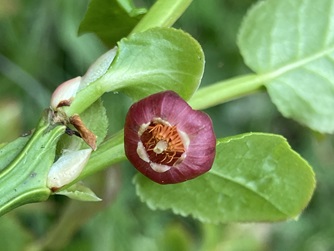
Vaccinium myrtillus (Bilberry) 9 cm pot
Vaccinium myrtillus (Bilberry) is a hardy, native Irish woodland shrub with delicate green stems and sweet, dark-blue berries. Widely recognised today for its effects on blood glucose, eye health, and cardiovascular support.
Description
Growth habit & appearance: Vaccinium myrtillus forms a small, deciduous shrub with slender, angular green stems and fine, bright leaves that turn rich red in autumn. In spring it produces delicate pink-green urn-shaped flowers, followed in summer by dark blue berries with intensely pigmented flesh—far richer in anthocyanins than cultivated blueberries. As a native Irish species, bilberry integrates seamlessly into woodland and heathland ecologies, supporting pollinators with its flowers and birds and mammals with its fruit. Its rhizomatous growth allows it to form carpets in undisturbed woodland soils, playing a critical role in forest-floor biodiversity.
Growing conditions: A fully hardy perennial and native Irish species, Bilberry thrives in acidic, free-draining soils in full sun to partial shade. Carefully collected from our woodland and propagated through root division in our nursery. It is naturally suited to the humid, temperate climate of Ireland and requires no feeding, preferring lean, low-nutrient ground. Once established, it is long-lived and maintains itself with minimal input.
Traditional & herbal uses: Bilberry has a long record of use for metabolic and vascular health. Modern practice and several peer-reviewed studies highlight anthocyanin-rich bilberry extracts for supporting blood-glucose regulation, improving microvascular function, and contributing to lipid balance. Research also notes benefits for visual performance and night vision due to improved retinal circulation and antioxidant capacity. Leaves have been used for urinary tract complaints, though contemporary practice emphasises the berries due to their strong evidence base and superior safety profile. As a woodland species, bilberry fruit is also a key ecological food source for native wildlife.
Maintenance & harvesting: Bilberry requires little intervention once established. Maintain acidic soil conditions, avoid lime, and allow leaf litter to accumulate naturally. Plants can be divided in spring by lifting and separating rhizomatous sections. Berries ripen through summer—harvest before the birds claim them. Pruning is rarely necessary, though removing older stems can encourage new, productive growth. Because it thrives in low-nutrient soils, no feeding is required.
Reviews
There are yet no reviews for this product.